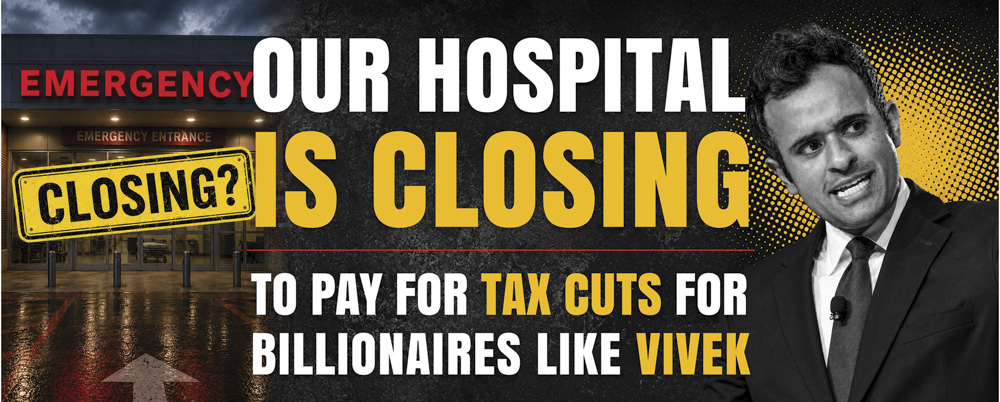
Vivek Ramaswamy defended the federal tax-and-spending law that puts rural health care in Ohio at risk. Now he wants Ohioans to trust him to clean up the damage.
Donald Trump signed the so-called “One Big Beautiful Bill” on July 4, 2025. The law delivers enormous tax benefits to corporations and wealthy Americans while cutting federal Medicaid and CHIP spending by an estimated $911 billion over ten years.
As Congress rushed the bill toward Trump’s desk, Ramaswamy went on Fox News to defend it against criticism—even criticism from his billionaire political ally Elon Musk. Ramaswamy was not a member of Congress and did not cast a vote, but he chose to use his platform to help sell the bill.
The cynical, self-serving calculation is hard to miss: Ramaswamy embraced a law built around extending and expanding tax breaks that overwhelmingly reward people at the top, then left rural Ohio to absorb the consequences of its historic health-care cuts.
He backed the tax cuts. He dismissed Medicare and Medicaid as mistakes. But he has offered no funded plan that replaces the federal dollars rural hospitals are losing.
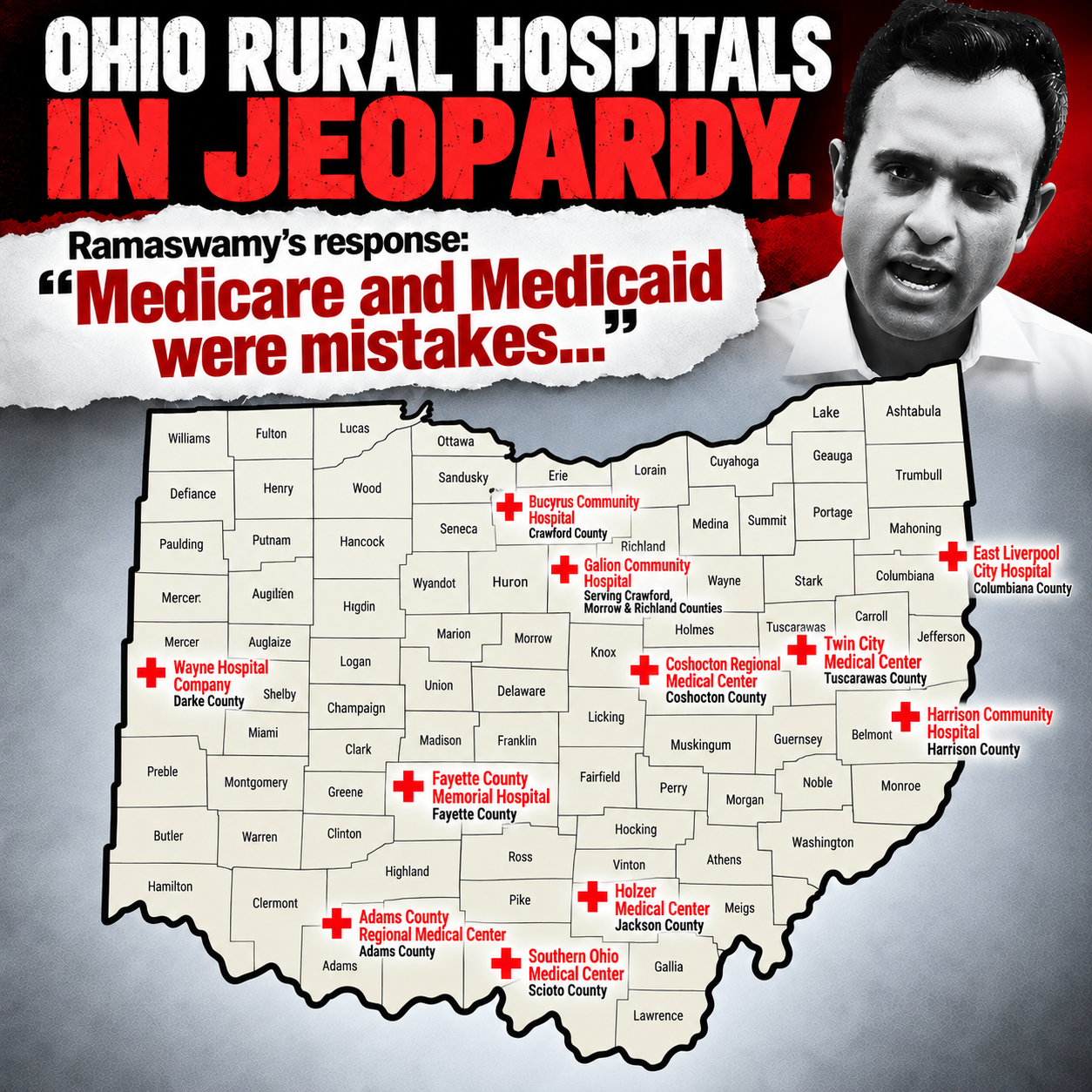
Eleven Ohio Hospitals Flagged at Risk
EVIDENCE 003-B
A 2025 analysis identified eleven rural Ohio hospitals vulnerable to financial distress, service reductions, conversion or closure under the new Medicaid cuts.
The hospitals were identified because they ranked among rural facilities with the highest shares of Medicaid patients, had suffered three consecutive years of negative total margins, or both. The list is a warning about financial exposure—not a claim that every facility has announced it will close.
An important clarification
Wayne HealthCare publicly disputed that it was in jeopardy of closing and said it had no plan to cut services. The facility nevertheless appeared in the national risk analysis because of the study’s financial criteria. Conditions and projections can change; the central fact remains that rural hospitals with thin margins and heavy Medicaid reliance face added pressure when coverage and reimbursement dollars disappear.
Vivek’s Record on Medicare and Medicaid
EVIDENCE 003-C
Ramaswamy’s hostility to the health-care safety net is not speculation. It is on tape.
Asked in an October 2024 interview whether the creation of Medicare and Medicaid was a mistake, Ramaswamy answered that it was—emphasizing Medicaid in particular. That view matters in Ohio, where roughly three million people depend on Medicaid and rural hospitals rely heavily on its payments.
His 2026 campaign proposal focuses on finding Medicaid fraud and seeking federal permission for Ohio to keep a share of claimed savings. His campaign now says some unspecified portion of those savings could be used for rural hospital stabilization, emergency services and community health centers.
But a promise to share hypothetical future savings is not a replacement plan. Ramaswamy has not identified a guaranteed appropriation, a hospital-by-hospital commitment, a timetable or a funding stream large enough to make rural providers whole for the federal Medicaid losses he defended.
Longer Drives
When a nearby hospital or emergency department closes, stroke, heart-attack and trauma patients can lose precious time traveling farther for care.
Fewer Services
Financial pressure often appears first as reductions in maternity care, inpatient beds, behavioral health and other essential services.
Lost Jobs
Rural hospitals are often among a county’s largest employers. Cuts ripple through local businesses, tax bases and entire communities.
Ohio does not need another billionaire telling rural families to accept less health care so people like him can keep more.
The eleven-hospital list reflects a 2025 risk analysis, not an announcement that every named facility will close. Subsequent studies have used different methods and produced different Ohio totals.